SIGN THE PETITION!
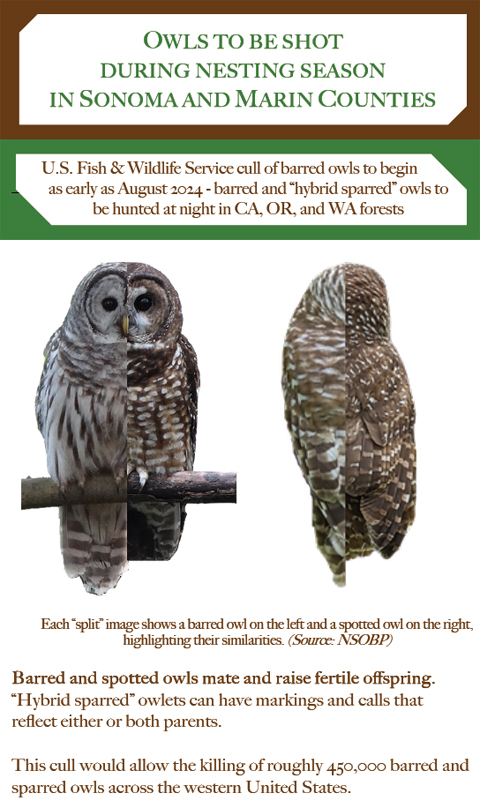
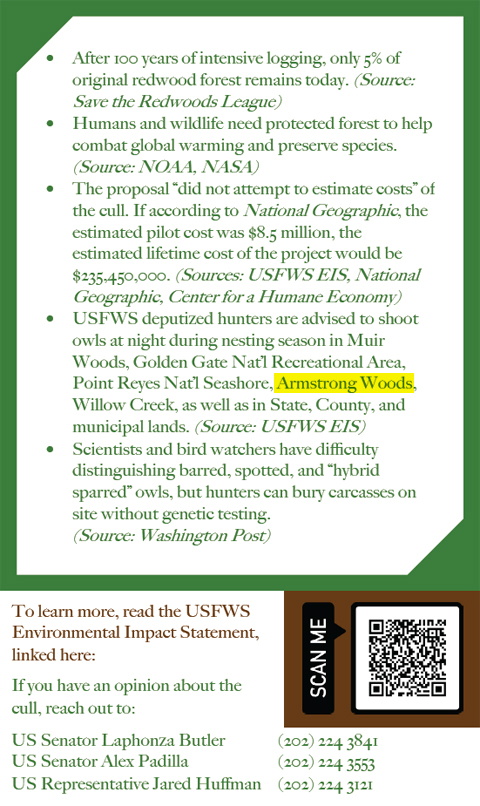
PDF an informational flyer:
HERE
US Fish and Wildlife Service Barred Owl "Management" page.
The first headline on the F&WS page refers to Barred Owls as a "non-native and invasive" species: THIS IS A LIE. Barred Owls are native to America and are supposed to be protected by the Migratory Bird Treaty Act of 1913. To be "non-native" the species must origininate from another country! Combining "invasive" with "non-native" is extremely misleading; the native Barred Owl has just adapted to habitat and environmental changes more successfully than the Spotted Owl.
A thoughtful letter:
Subject: Critical research to be considered before decision is made regarding barred owl cull
Dear Madame Secretary Haaland,
First let me express my gratitude for your role in helping to secure good relations for all kin. Your nomination and confirmation represented a long-overdue moment in United States history, and my family and I are grateful for your specific experience and expertise guiding your leadership.
After reading headlines reporting on the U.S. Fish and Wildlife Service proposal to cull federally protected barred owls to save their federally protected spotted owl kin, and after reviewing the research pertinent to this issue, I believe it is crucial for your office to adopt the ES 2.1 Alternative 1 “No Action” course.
The language being used by Service spokespersons is inflammatory and scattered with eugenic allusions, the actual proposal is inspired by timber company research, and the plan to cull these federally protected, migratory barred owls is hasty, expensive, and dangerous. Placing hunters with shotguns 0.25 mile from human dwellings and 300 yards from known spotted owl nests, this lethal removal strategy will kill 470,000 barred owls as well as the endangered spotted owlsit is purported to save.
Service spokespersons are using highly inflammatory and coded language linked to the eugenics movement. Genetically dilute, genomic hygiene, genetically homogenous, genetic integrity, genetic swamping, invasion, replacement, colonize,purity, hybrids, exclusion, fully eradicate, relocation, and removal have no place in governmental rhetoric—especially pitting one kin against a labeled “other.” The public might not be aware of the intersections between ornithology and eugenics. I would expect Service biologists and ornithologists to know well the histories of Linnaeus, de Candolle, Darwin, Audubon, and Merriam. These men believed in superior and inferior races and are foundational to the life sciences and the naming of the spotted owl.
The Service must be aware of the 2023 NPR article, “Audubon faces a backlash after deciding to keep name that evokes a racist enslaver,” and the three board members who resigned after this decision. They also must have seen the 2023 CNN article published just five months ago, “Nearly 80 bird species names with racist roots are about to be changed.”
Since the 1883 American Ornithologist Union “led to [the] formation of the National Audubon Society and the Biological Survey (now known as the U.S. Fish and Wildlife Service),” it seems certain Service scientists know the history of the USFWS founding, thus its delicate relationship with Audubon’s racist legacy. If not, they should.
Also, in the 3.10.3 “Impacts to Tribes” section of the proposal, representing only two paragraphs, the following sentence invites serious reflection: “In January 2022, Tribes were invited to participate as cooperating agencies on this Draft EIS, though none chose to do so.” One read might accept the Service’s conclusion “none chose to do so,” as evidence of Tribal agreement with the proposed cull. Another read could suggest “none chose” to be a cooperating agency on this draft EIS to kill barred owls. While the studies on the Hoopa Reservation represent “the longest running barred owl removal study,” this Tribe is only mentioned twice in the 264-page proposal, and the marginalization written into the previous quotation “none chose,” reflects a serious dismissal of good relations between the Service and Indigenous communities across the West.
Economically and politically, the proposal—obviously motivated by timber industry research—is expensive, hurried, and precedent-setting. One timber company is specifically named four times as the stakeholder responsible for initiating the culling experiments starting in 2004 (see the first paragraph in the “Dedication” section: page 190). This timber company biologist is described as “the original proponent of the need for barred owl management” who “set the standards we use today and include in the Strategy.”
This certainly looks like conflict-of-interest at best or collusion at worst. Also, this proposal is predicated on permits that will waive obligations to comply with the Migratory Bird Treaty Act. If approved, the proposal will establish a negative precedent that could be used by future parties seeking to avoid federal mandates connected to critical environmental protections.
Finally, this Service proposal is dangerous—to humans and to the endangered spotted owl it professes to save. The actual language of Appendix 2 that details the specific protocols of the hunt (built upon one cited source—a 2023 Oregon State University dissertation: page 216) says 20-gauge shotguns should be fired at night, during nesting season, 0.25 mile from humans and 300 yards from active spotted owl nests.
While hunters are required to notify “appropriate law enforcement” to “minimize public concerns over nighttime discharge of firearms,” they need only “consider contacting local landowners.” A list “of veterinary resources and wildlife rehabilitation facilities” are required in case of “injury or death of ‘non-target species.’” Numerous paragraphs detail the reality of spotted owl and spotted owl/barred owl hybrid casualties during the nighttime hunts. Hunters are required to submit reports to notify the Service of unfortunate “takes.” What is the Service’s goal by killing spotted owl hybrids: maintaining “genetic purity” for owls or maintaining endangered owls?
Adopting the ES 2.1 Alternative 1 “No Action” course would 1) save taxpayer money, 2) curtail a slippery slope in which more federal protections could be waived for novel proposals, and 3) protect humans, endangered animals, and all wildlife from dangerous hunts occurring in the middle of the night.
Instead, your office could bring attention to the real threats endangered spotted owls face and encourage actions that support serious conservation. After intensive deforestation from the late 1800s to 1990, the 1970s increase in global warming, and the significant increase in wildfires starting in 2000, the next biggest threat spotted owls face—according to numerous published studies—is second-generation anti-coagulant rodenticides (SGARs).
The first documented barred owl in America was observed in the 1970s. This was the exact decade when SGARs were released, making some owls, especially those who prefer rodent prey like the spotted owl, “[die] under gruesome circumstances, bleeding to death from stomach hemorrhages in an agonizing and days-long decline.” U.S. Environmental Protection Agency and Canadian biologists rang warning bells regarding this class of chemical in the early 2000s, seeing not only spotted owl deaths, but over “300 incidents” of suspected chemical deaths.
In 2018, a UC Davis study concluded illegal marijuana farms using SGARs were responsible for “70 percent of northern spotted owls and 40 percent of barred owls [testing] positive for poison.” In 2020 California became the first state to ban SGARs. Spotted owls are especially susceptible to SGARs as they are known to prefer rodents, as opposed to barred owls who consume a more varied diet including amphibians, invertebrates, and fish—one of the main reasons they are surviving in larger numbers than their kin.
>
>
>
The 2021 study, called the “Invader removal” study, upon which the USFWS builds most of its case (and the study often referenced in media coverage), reports a 12.1% decline of spotted owls without barred owl removal, and a .2% decline with removal. In the 2.10.10 “Northern spotted owl captive propagation or translocation” section of the proposal, the Service admits another non-lethal alternative “could be a valuable component of a larger spotted owl recovery strategy.” Does the Service want to support a robust spotted owl recovery, or does it want to put spotted owls (and others) in harm’s way? Rodenticides are not mentioned once in this proposal, whereas the description of barred owls “invading” is mentioned almost 100 times.
In the 1970s when the DDT ban went into effect, the endangered peregrine falcon recovered. They were delisted in 1999. Multiple studies proved they benefited dramatically from this federal ban. What if the U.S. Fish and Wildlife Service disconnected itself from this dangerous, hasty proposal and instead advocated for a federal ban of SGARs?
Curbing deforestation, mitigating global warming, and implementing wildfire prevention strategies are necessary, but they are complex and nuanced. A federal ban on SGARs is prudent and practical. The U.S. Fish and Wildlife Service, inspired by guidance from your office, could link hands with other wildlife organizations to educate and mobilize Americans to ban a deadly pesticide that poisons spotted owls, wildlife, pets—and sometimes even humans.
The federally protected barred owl is being used as a political pawn, a red herring, and a scapegoat. Your office can direct USFWS spokespersons to end immediately the careless use of offensive and allusive diction, it can adopt the ES 2.1 Alternative 1 “No Action,” and it can continue to protect the spotted owl by advocating for a federal ban of SGARs.
Thank you again for your leadership,
Simone Spearman
Guerneville, California
CC:
U.S. Fish and Wildlife Service
Center for Biological Diversity
Animal Wellness Action